

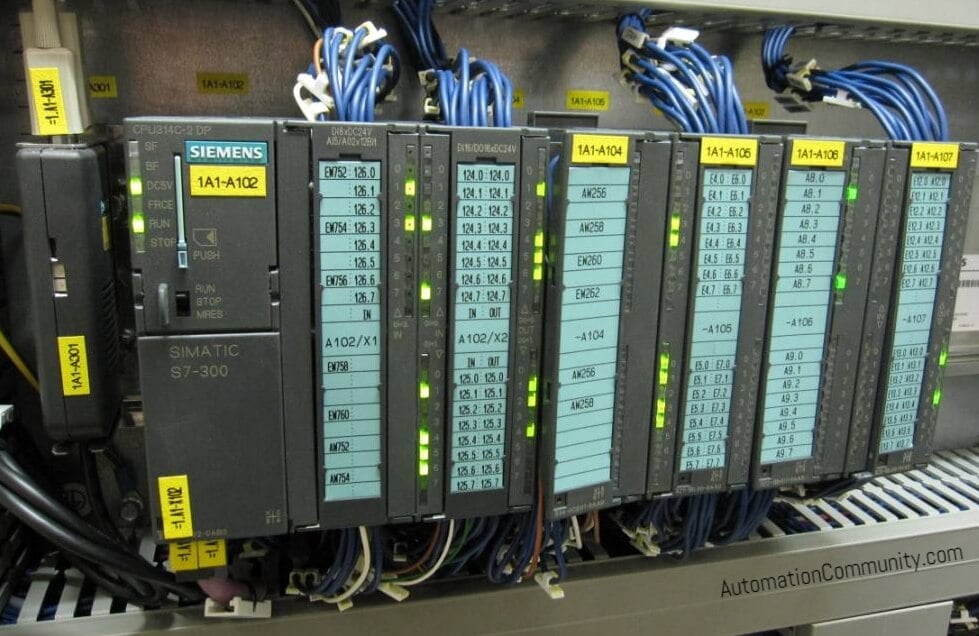
Study the process control multiple-choice questions and answers with explanations related to industrial instrumentation.
Process Control Multiple-choice Questions
Question 1:
What is the primary purpose of process control?
a) To automate production processes
b) To ensure the quality of the final product
c) To optimize production efficiency
d) To monitor and regulate process variables
Answer:
d) To monitor and regulate process variables
Explanation:
The primary purpose of process control is to monitor and regulate process variables such as temperature, pressure, flow rate, and chemical composition to maintain the desired output and stable operation.
Question 2:
What is the main principle of Proportional control?
a) The control action is proportional to the error signal
b) The control action is inversely proportional to the error signal
c) The control action is a fixed value
d) The control action is based on the time-based change in the error signal
Answer:
a) The control action is proportional to the error signal
Explanation:
Proportional control is a feedback control method where the controller output is directly proportional to the error between the setpoint and the measured process variable.
Question 3:
What is the main principle of Integral control?
a) The control action is proportional to the error signal
b) The control action is based on the accumulated error over time
c) The control action is a fixed value
d) The control action is based on the time-based change in the error signal
Answer:
b) The control action is based on the accumulated error over time
Explanation:
Integral control sums the error over time and adjusts the control output to eliminate steady-state error that cannot be corrected by proportional control alone.
Question 4:
What is the main principle of Derivative control?
a) The control action is proportional to the error signal
b) The control action is based on the accumulated error over time
c) The control action is based on the rate of change of the error signal
d) The control action is a fixed value
Answer:
c) The control action is based on the rate of change of the error signal
Explanation:
Derivative control responds to the rate at which the error changes, helping anticipate future error and improving system stability and response.
Question 5:
What is the main function of a flow meter?
a) To measure the flow rate of a process
b) To adjust the flow of a process
c) To perform logical operations and control equipment
d) To provide feedback control
Answer:
a) To measure the flow rate of a process
Explanation:
A flow meter measures the rate of fluid movement in a process and provides critical input for monitoring and control systems.
Question 6:
What is the main function of a temperature sensor?
a) To measure the temperature of a process
b) To adjust the flow of a process
c) To perform logical operations and control equipment
d) To provide feedback control
Answer:
a) To measure the temperature of a process
Explanation:
Temperature sensors such as thermocouples and RTDs detect process temperature and transmit signals to controllers for monitoring and regulation.
Question 7:
What is the difference between a continuous process and a batch process?
a) Continuous processes have a steady state while batch processes do not
b) Batch processes are more efficient than continuous processes
c) Continuous processes produce a single product while batch processes produce multiple products
d) Batch processes are more flexible than continuous processes
Answer:
a) Continuous processes have a steady state while batch processes do not
Explanation:
Continuous processes operate continuously at steady conditions, while batch processes run for a fixed duration and stop before the next cycle.
Question 8:
What is the role of a control valve in a process control system?
a) To adjust the flow rate of a fluid in the process
b) To measure the temperature of the process
c) To monitor the pressure in the process
d) All of the above
Answer:
a) To adjust the flow rate of a fluid in the process
Explanation:
Control valves regulate fluid flow by changing valve position based on controller output, maintaining the desired process conditions.
Question 9:
Which of the following is a common tool used in process control?
a) PLC (Programmable Logic Controller)
b) HMI (Human-Machine Interface)
c) SCADA (Supervisory Control and Data Acquisition)
d) All of the above
Answer:
d) All of the above
Explanation:
PLC, HMI, and SCADA systems collectively automate, monitor, and visualize industrial processes.
Question 10:
What is the purpose of a control algorithm in a control system?
a) To control the process variables
b) To analyze the process data
c) To provide instructions to the actuators
d) All of the above
Answer:
d) All of the above
Explanation:
A control algorithm processes sensor data, evaluates system behavior, and generates actuator commands to maintain desired operation.
Question 11:
What is the key difference between a PID controller and a fuzzy controller?
a) PID uses mathematical equations while fuzzy uses linguistic rules
b) PID is more precise while fuzzy is more robust
c) Fuzzy is more complex while PID is simpler
d) PID is feedback-based while fuzzy is feedforward-based
Answer:
a) PID uses mathematical equations while fuzzy uses linguistic rules
Explanation:
PID controllers rely on mathematical models, while fuzzy controllers use rule-based logic derived from human experience.
Question 12:
What is the main disadvantage of using a cascade control system?
a) More complex and difficult to implement
b) More expensive
c) More sensitive to disturbances
d) Less precise control
Answer:
a) More complex and difficult to implement
Explanation:
Cascade control improves performance but increases system complexity, requiring additional sensors and tuning.
Question 13:
What is the main advantage of using a model-based control system?
a) It can handle non-linear systems
b) It can handle unknown dynamics
c) It can handle multiple inputs and outputs
d) It can predict future process behavior
Answer:
d) It can predict future process behavior
Explanation:
Model-based control uses process models to forecast behavior, enabling better control decisions.
Question 14:
What is the main advantage of using a multivariable control system?
a) It can handle multiple inputs and outputs
b) It can handle non-linear systems
c) It can handle unknown dynamics
d) It can predict future process behavior
Answer:
a) It can handle multiple inputs and outputs
Explanation:
Multivariable control systems manage interactions between multiple variables, improving control in complex processes.
Question 15:
What is the main disadvantage of using a self-tuning control system?
a) It is more complex to design and implement
b) It is less precise
c) It is less robust
d) It is more sensitive to disturbances
Answer:
b) It is less precise
Explanation:
Self-tuning controllers adapt automatically but may not achieve the precision of manually tuned controllers.
Question 16:
What is the main disadvantage of using an adaptive control system?
a) It is less robust
b) It is more complex to design and implement
c) It is less precise
d) It is more sensitive to disturbances
Answer:
b) It is more complex to design and implement
Explanation:
Adaptive control systems require accurate models and higher computational resources, increasing complexity.
Question 17:
What is the main purpose of a control loop?
a) To measure process variables
b) To control the flow of a process
c) To convert electrical signals into mechanical motion
d) To provide feedback control
Answer:
d) To provide feedback control
Explanation:
A control loop continuously compares the process variable with the setpoint and corrects deviations using feedback.
Question 18:
What is the main purpose of a PID controller?
a) To measure process variables
b) To control the flow of a process
c) To convert electrical signals into mechanical motion
d) To provide feedback control with P, I, and D actions
Answer:
d) To provide feedback control with P, I, and D actions
Explanation:
PID controllers combine proportional, integral, and derivative actions to achieve stable and accurate control.
Question 19:
What is the main purpose of a cascade control system?
a) To measure process variables
b) To control the flow of a process
c) To control a primary variable using a secondary variable
d) To provide PID feedback control
Answer:
c) To control a primary variable using a secondary variable
Explanation:
Cascade control improves response by correcting disturbances early through a secondary control loop.
Question 20:
What is the main purpose of a feedforward control system?
a) To measure process variables
b) To control the flow of a process
c) To anticipate and compensate for disturbances
d) To provide PID feedback control
Answer:
c) To anticipate and compensate for disturbances
Explanation:
Feedforward control reacts to measured disturbances before they affect the process output.
Question 21:
What is the main purpose of Statistical Process Control (SPC)?
a) To measure process variables
b) To control the flow of a process
c) To monitor and control process quality
d) To provide PID feedback control
Answer:
c) To monitor and control process quality
Explanation:
SPC uses statistical methods to detect process variation and prevent quality defects.
Question 22:
What is the main function of a pressure sensor?
a) To measure the pressure of a process
b) To adjust the flow of a process
c) To perform logical operations and control equipment
d) To provide feedback control
Answer:
a) To measure the pressure of a process
Explanation:
Pressure sensors convert pressure into electrical signals for monitoring and control purposes.
Question 23:
What is the main function of a temperature controller?
a) To measure the temperature of a process
b) To adjust the temperature of a process
c) To perform logical operations and control equipment
d) To provide feedback control
Answer:
b) To adjust the temperature of a process
Explanation:
Temperature controllers regulate heating or cooling to maintain the desired temperature setpoint.
Question 24:
What type of control system is commonly used in industrial applications?
a) Open-loop control system
b) Closed-loop control system
c) PLC control system
d) SCADA control system
Answer:
b) Closed-loop control system
Explanation:
Closed-loop control systems use feedback to continuously correct process deviations, making them ideal for industrial automation.


endaylalu wubale
February 14, 2025this is best question i accept